
What this document is
The standard for screening, referring, assisting, monitoring and measuring Medicaid, CHIP, Marketplace and related health-coverage needs among Veterans, families, caregivers and survivors.
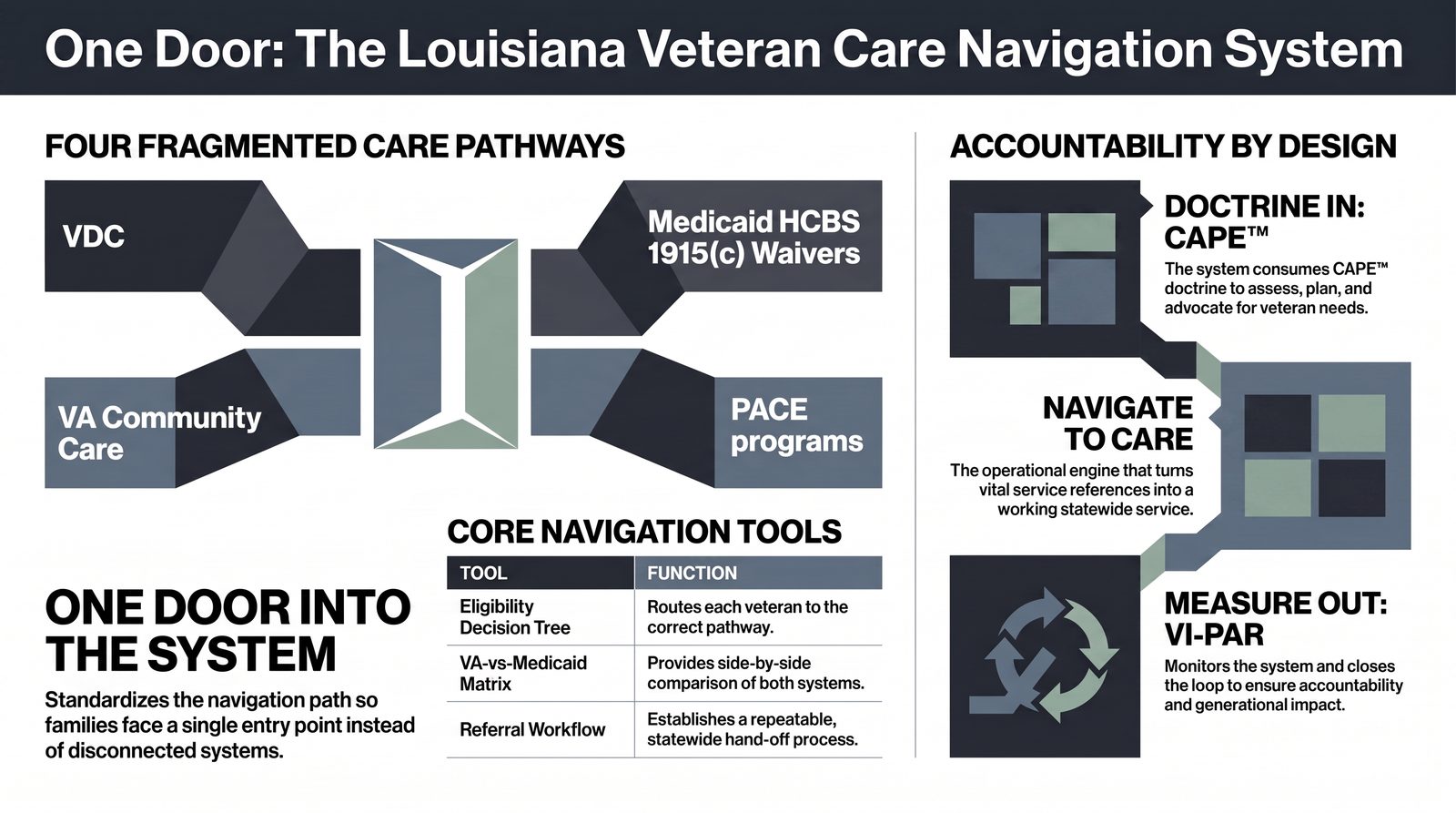
The problem it solves: veterans and caregivers face The problem it solves: eligible people lose coverage for paperwork reasons. Louisiana warns explicitly that failure to respond to a request can close coverage even when the person still qualifies. That is a preventable loss, not an eligibility loss.. The framework standardizes the path so families face one door, not many.
It is designed to become a It complements rather than repeats the waiver-care navigation system. That document handles long-term-care pathways; this one handles eligibility, enrolment, renewal retention, community-engagement requirements and the Marketplace. and a repeatable reference for the navigation team, with VI-PAR™ monitoring closing the loop.
2026 is the preparation year
Federal community-engagement requirements begin in Louisiana on January 1, 2027 for affected applications and renewals. They do not generally apply during 2026.
The trap is in the look-back. For a member renewing in January 2027, Louisiana may examine whether the requirement was met during at least one month from May through October 2026 — a window that closes before most organisations have started preparing.
Affected adults will generally need 80 hours per month of qualifying work, education, training or community service, or monthly earnings of at least $580, unless exempt.
Separately, retroactive Medicaid contracts from October 1, 2026 — roughly one month for adults 19 to 64. Applications after a medical event must now move faster than they used to.
The Veteran exemption nobody should miss
Louisiana identifies a Veteran with a total disability rating among the exempt populations. Medical frailty and certain caregiving circumstances also exempt.
This has an operational consequence: intake must never route every working-age Veteran into a work-requirement compliance track by default.
The screening order is Veteran status, then disability status, then other exemptions, then Medicaid eligibility, then other coverage, then household coverage.
Veteran status and exemption status are recorded as two separate fields. Staff never infer one from the other.
VA coverage does not cover the family
VA health-care eligibility belongs to the Veteran. Spouses and dependents may need Medicaid, CHIP, Marketplace, TRICARE, CHAMPVA or employer coverage.
Every assessment therefore captures a household coverage profile — VA, Medicare, Medicaid, CHAMPVA or TRICARE, employer, Marketplace, uninsured — for each member, not a single yes-or-no about the Veteran.
The Marketplace also changed. The temporary premium-tax-credit expansion ended after 2025, the income ceiling returns to 400 percent of the federal poverty level, and stronger income, special-enrolment and tax-reconciliation verification now applies.
Losing coverage without losing eligibility
The renewal early-warning system runs at 120, 90, 60 and 30 days, with a 15-day critical alert and a 7-day post-loss rapid response.
At 120 days validate contact information and household. At 90, review eligibility and exemption and identify missing evidence. At 60, assemble documentation and coordinate with the Navigator or the state. At 30, confirm submission and escalate anything unresolved.
Coverage-loss escalation runs four levels — routine, at risk, coverage interrupted, and critical access risk where loss coincides with urgent medication, treatment, hospitalisation, pregnancy or a serious behavioural-health concern. The top level escalates the same day.
The line staff must not cross
Eligibility is determined by the Louisiana Department of Health and by CMS. It is not determined by us.
Staff record and say "potentially eligible — referral and verification required." They never say "eligible." The difference is the difference between navigation and unauthorised determination.
Enrolment assistance itself routes to credentialed Navigators. Southwest Louisiana Area Health Education Center provides free Medicaid, LaCHIP and Marketplace help through Navigators for a Healthy Louisiana — they do the work we should not be doing.
Our distinctive role is orchestration, not duplication: find the coverage problem, assess the whole household, assemble documentation, make a warm referral, track it to resolution, and measure the outcome.
Coverage retention is the number that matters
Retention rate — members who keep or successfully transition coverage, divided by members facing renewal or disruption. Target at or above 90 percent where the Consortium has adequate lead time and participant cooperation.
Supporting measures: screening completion, referral acceptance, document readiness before deadline, renewal intervention at least thirty days early, warm-referral closure, and same-day escalation of every critical-risk case.
This module refreshes annually. Federal and Louisiana implementation are actively changing, and a coverage document that is a year out of date is worse than none — because staff will trust it.
The The coverage continuum for — the most build-ready operational system in the library. It consumes CAPE™ and the Vital Services reference and turns them into a working statewide service.
This anchor is a draft until leadership shapes it. As you read:
- Which of our current participants face a January 2027 renewal?
- Who on staff is authorised to say the words "potentially eligible"?
- Which Navigator organisation do we route to first?